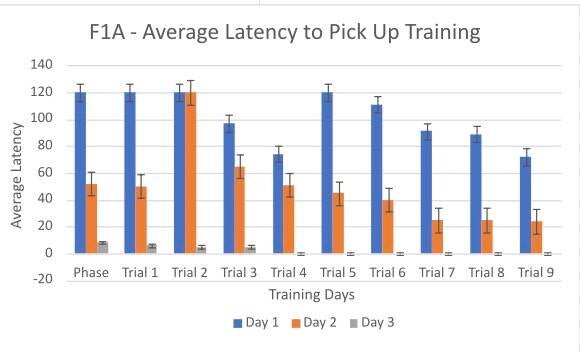
In Figure 1A, average latency decreased from 101.4 ± 6.1 seconds on Day 1 to 49.7 ± 8.9 seconds on Day 2 and 2.4 ± 1.0 seconds on Day 3. A Wilcoxon signed-rank test indicated a significant decrease in latency between the first and final training day of the Pick Up phase (W = 55.0, P = 0.001).
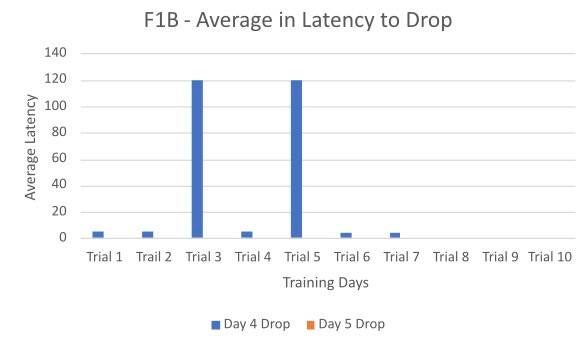
In Figure 1B, average latency decreased from 26.3 ± 14.9 seconds on Day 4 to 0 ± 0 seconds on Day 5. A Wilcoxon signed-rank test indicated a significant decrease in latency between the first and final training day of the Drop phase (W = 28.0, P = 0.008).
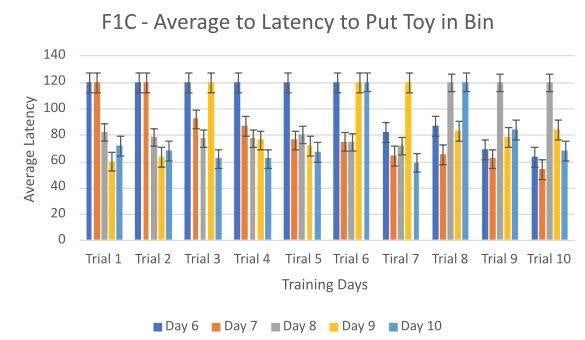
In Figure 1C, average latency decreased from 102.1 ± 7.2 seconds on Day 6 to 78.2 ± 7.0 seconds on Day 10. Intermediate average latencies of 81.5 ± 7.0 seconds, 90.1 ± 6.3 seconds, and 87.6 ± 7.1 seconds were observed on Days 7, 8, and 9, respectively. A Wilcoxon signed-rank test indicated a significant decrease in latency between the first and final training day of the Toy in Bin phase (W = 38.0, P = 0.037).
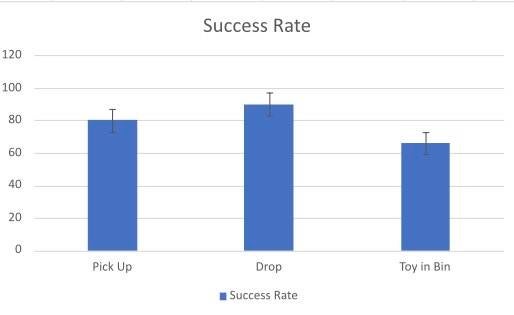
In Figure 2, Josie successfully completed an average of 80% of trials during the Pick Up phase, 90% of trials during the Drop phase, and 66% of trials during the Toy in Bin phase. Task completion success was highest during the Drop phase and lowest during the Toy in Bin phase.
Create Your Own Website With Webador