
Research Subject
The subject used in this study is one domestic dog, Josie. Josie is a 5 year old mixed-breed female dog with previous training experience in obedience such as sit, stay, fetch, and recall. Throughout the study, Josie remained in her normal home environment and participated voluntarily in all training sessions. Her prior experience with retrieving toys, responding to verbal commands, as well as her being an easy subject to access this made her an excellent subject for investigation.
Experimental Design
The purpose of this study was to determine whether positive reinforcement shaping could be used to teach a dog to return toys to a designated storage bin. Training was conducted over ten consecutive days and consisted of three sequential training phases of increasing difficulty.
Phase 1 focused on teaching Josie to pick up her toy with the command "get your toy". Phase 2 focused on teaching her to drop her toy with the command "drop". Phase 3 focused on teaching her to place the toy into the designated storage bin with the command "in the bin".
Training was conducted using positive reinforcement in which correct behaviors and successive approximations of the final behavior were rewarded using verbal praise "good girl" and Bark Box Beef Jerky Bar treats. One training session was conducted per day, which each session consisting of ten trials. A trail was defined as one verbal command followed by Josie's response.
To reduce variability, the same toy, reward, verbal commands, training location, and approximate training times were used through the study.
Ethogram
| Behavior | Type | Definition | Measurement |
|---|---|---|---|
| Latency to Respond | State | Time from verbal command to successful completion of requested behavior. | Seconds |
| Task Completion Success | Event | Wether the requested bahavior was successfully completed during trial. | Yes/No |
| Engagement with Task | State | Total time actively interacting with the toy or participating in the training task. | Minutes |
Data Analysis
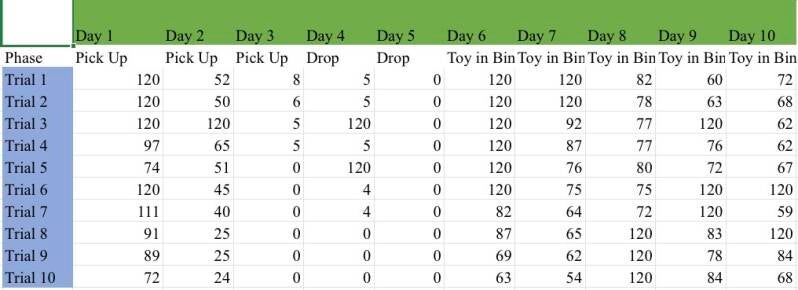
Latency to Respond
Latency data was recorded in seconds for each trial and entered into Microsoft Excel. Latency was measured as the amount of time between the verbal command and successful completion of the requested behavior. The maximum trial duration was 120 seconds. If Josie did not complete the behavior within 120 seconds, the trial was terminated and recorded as 120 seconds. Behaviors completed immediately following the verbal command were recorded as 0 seconds. The average latency for each training day was calculated from the ten trials and used to evaluate changes in performance across training phases. Summary statistics including the mean, standard deviation, standard error, and variance were calculated. A Wilcoxon signed-rank test was selected to evaluate differences in latency due to the repeated measurements collected from a single subject and the relatively small sample size.
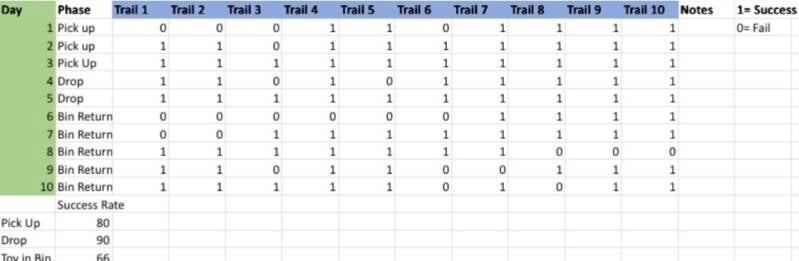
Task Completion
Task completion success was recorded for each trial using binary scoring. A score of 1 indicated that Josie successfully completed the requested behavior within the 120-second trial period, while a score of 0 indicated that the behavior was not completed or that the 120-second time limit was reached. The total number of successful trials was summed for each training session and converted to a daily success percentage. Success percentages were then compared across training phases to assess improvements in behavioral performance over time. Summary statistics including the mean success rate, standard deviation, standard error, and variance were calculated. A Wilcoxon signed-rank test was used to evaluate differences in success rates between training phases.
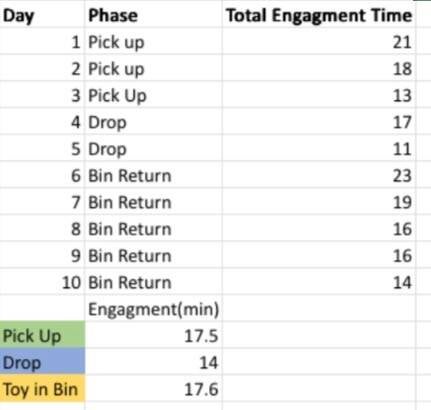
Engagement with Task
Engagement duration was measured using video recordings of each training session. Engagement was defined as the amount of time Josie remained actively focused on the training activity, including interacting with the toy, carrying the toy, or attempting the requested behavior. Periods of distraction, inactivity, or disengagement from the task were not included in engagement measurements.
The total engagement time for each training session was calculated and recorded in minutes. Daily engagement values were entered into Microsoft Excel and compared across training phases to assess changes in participation throughout the shaping process. Summary statistics including the mean, standard deviation, standard error, and variance were calculated. A Wilcoxon signed-rank test was used to assess differences in engagement duration across training phases.
Create Your Own Website With Webador